Cooked is a number, not a colour
A hamburger that looks done is, one time in four, not. The federal chart is short, the probe placement rule is one sentence, and between them a roast stops being a gamble.
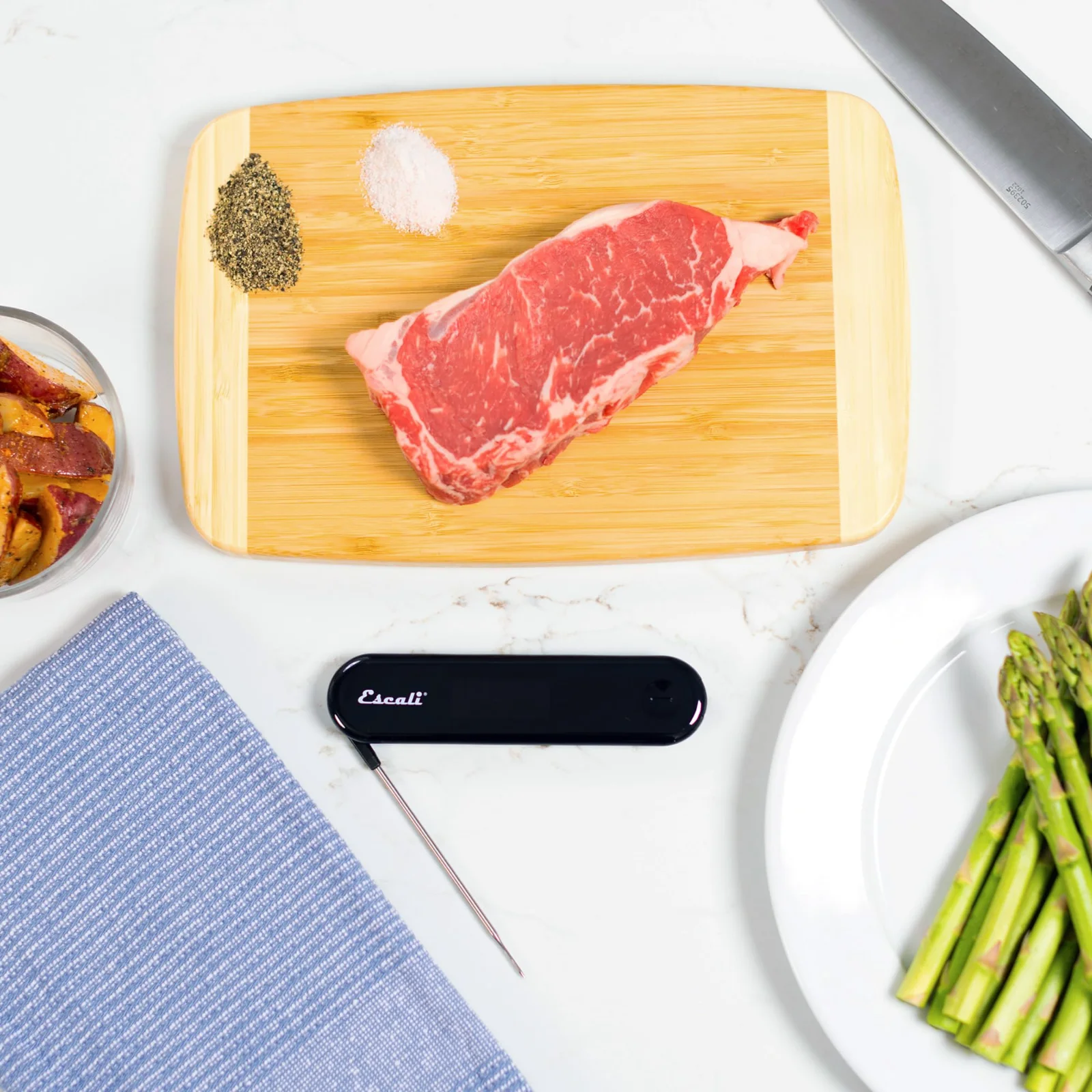
You stand at the stove with a spatula in hand. The patties have gone gray across the outside and the juices pooling on the surface look clear. You press one with your thumb and it feels firm. That should mean it is done. Most home cooks judge a hamburger this way, by eye and touch. The United States Department of Agriculture says that even when a hamburger looks fully cooked, one in four may not be safely cooked. Only about six percent of people use a thermometer on ground meat. For chicken breasts, the figure is about ten percent. Across all cooking, only about fifteen percent of people consistently use a food thermometer at all. The color of the meat, the texture of the crust, the look of the juices: none of it is a reliable indicator of safety or doneness. The federal agencies are explicit on this point. Appearance and color are not reliable indicators of safety or doneness. Cooked is a number, not a color.
Why color lies
A gray center, clear juices, or a springy surface have been trusted for generations. They signal that heat has reached the interior, but they do not confirm that the interior has reached the temperature required to reduce pathogens to safe levels. The only variable the federal food-safety service treats as definitive is internal temperature. Everything else is guesswork. Your eyes can judge a crust and a colour. They cannot see 160 F.
This is not a matter of skill. Bacteria do not die at the exact moment meat turns gray. A burger seared hard on a cast-iron skillet can look cooked on the outside while the center has barely warmed, and a roast in a low oven can look uniformly brown while the interior is still climbing. Relying on appearance means accepting a one-in-four chance on your ground beef, and most kitchens accept it nightly without knowing they are betting at all.
The federal chart
The USDA Food Safety and Inspection Service and the FDA publish a short list of targets. These are minimums, not suggestions. Whole cuts of beef, pork, veal, and lamb, including steaks, chops, and roasts, must reach 145 F. Fresh ham shares the same target. Both require a three-minute rest after coming off the heat. Ground meats and egg dishes must reach 160 F. All poultry, including ground poultry, must reach 165 F. Leftovers and casseroles also belong at 165 F. Fish and shellfish are done at 145 F. There are no exceptions or regional variations in these numbers. They apply in every kitchen.
The rest time on whole cuts is not optional. When you pull a roast or a chop at 145 F, the exterior is hotter and the heat continues to migrate inward, and the three minutes are part of the target the way a unit is part of a number. In practice, this means you set the meat on a warm plate, leave the probe in place, and wait. Watch the reading. It may climb a degree or two. After three full minutes, you can slice.
The USDA also notes that when roasting meat and poultry, an oven temperature no lower than 325 F keeps the food moving through the danger zone at a safe pace.
| Dish | Federal target | Rest time | Instrument to reach for |
|---|---|---|---|
| Whole cuts of beef, pork, veal, lamb | 145 F | 3 minutes | Oven-safe dial or probe |
| Fresh ham | 145 F | 3 minutes | Oven-safe dial or probe |
| Ground meats and egg dishes | 160 F | None | Instant-read probe |
| All poultry, whole or ground | 165 F | None | Instant-read or oven-safe probe |
| Leftovers and casseroles | 165 F | None | Instant-read probe |
| Fish and shellfish | 145 F | None | Instant-read probe |
Notice that oven-safe instruments appear beside the foods that spend long periods in the oven. A roast beef or fresh ham benefits from a device that rides inside the meat while the door stays closed. Quick-cooking foods like burgers, fish fillets, and reheated leftovers are better served by a fast probe that visits, reports, and withdraws.
Where the probe goes
A thermometer is only as accurate as its placement. The federal instruction is to insert the probe into the thickest part of the food. This is the region that heats last. The outer edges of a roast or breast will always be hotter than the center. If you measure the edge, you will think the whole piece is ready when the middle is still climbing. Bone conducts heat differently than muscle. If the probe touches bone, it can read higher or lower than the surrounding meat, depending on how the bone has heated. Fat and gristle insulate. They can hold temperatures that do not reflect the state of the meat itself. A probe resting against the hip bone of a turkey or trapped in a seam of fat on a rib roast is telling you about the oven, not the meat. It is reading the thermal mass of bone or the slow-conducting tissue, and the number on the dial will mislead you.
The thickest part is usually geometrically obvious. In a chicken breast, it is the center of the plump end. In a pork loin, it is the midpoint of the cylinder. In a whole turkey, it is the thickest part of the thigh. Insert the probe from the side if the meat is thin, so you get enough depth. For a thick roast, insert from the top straight down into the geometric center. If you are using an oven-safe dial that stays with the food, place it before cooking and position the stem in that thickest zone. For visiting probes, check multiple spots if the cut is uneven. A tenderloin tapers. The thick end governs the doneness of the whole piece. If the probe is in a thin part or touching the roasting pan, you are reading the oven, not the meat.
Dials that stay, probes that visit
Our catalogue divides the task into two families. Dials stay with the food during cooking. Probes visit briefly and then move on.
An oven-safe dial such as our AH1 rides inside the roast with the oven door shut. Its 2.5 inch dial is large enough to read through the glass if you position it carefully. This is the instrument for long, uninterrupted roasting. You do not lose heat by opening the door. You do not need to fish around with a hot mitt while the oven vents steam. The AH3 is a large-dial instant read with a clip, suited to roasts or large cuts you want to monitor without holding the probe in place. The AHS1-4 set gives you four mini steak dials marked with doneness levels from rare to well. They stay embedded in individual steaks on the grill, so each diner's portion can be tracked to its own degree. The AH2 instant-read pocket dial has a 1 inch dial and a 5 inch probe with a protective sheath. It is compact enough to live in a drawer and travel to the grill.
Probes that visit are for quick decisions. The DH1 gourmet digital has an extra-long probe for deep pots or large cuts. The DHP4 is waterproof to IPX7 and reads in about four seconds, which matters when your hand is hovering over a hot skillet. The DH3 is a folding probe that protects its stem in a drawer or pocket. The Stelo is a rechargeable folding thermometer with a thermocouple tip for rapid response. For frying and deep pots, our long-stem digital carries a 5.6 inch probe that keeps your hand clear of bubbling oil. The DHRW1 wireless probe and timer reports from up to 200 feet away with an oven-safe probe. You can monitor a turkey in the oven while you set the table.
Grill surface dials are a separate category. The AHG1 reads 100 to 500 F and the AHG2 reads 100 to 600 F. They sit directly on the grate and tell you the temperature of the cooking surface, not the meat. This is useful for judging when the grill is ready for searing or for gentle indirect heat, but it does not replace a probe in the food.
Choosing between the families is simple. If the food cooks for more than twenty minutes and you want to know when it crosses the threshold without opening the oven or lifting the lid, use a dial or wireless probe that stays. If the food cooks quickly or you want to check several pieces in succession, use a visiting probe. The cards on our site print the probe length or dial size next to the price, so you can match the reach to the cut.
Deep frying and candy work
Hot oil and boiling sugar are dangerous to touch and unforgiving of timing. Our candy and deep-fry instruments are built around two features: the clip and the stem length.
The AHC1 has a 5 inch probe and a pot clip. The AHC2 has a 12 inch probe and a pot clip. Both have candy temperature zones printed on the dial. The clip matters because it holds the probe at the correct depth without your hand hovering over the pot. If the probe rests on the bottom of the pot, it reads the metal, not the oil. The bottom of a steel pot over a burner conducts heat directly from the flame. A probe touching bottom will give a false reading. The clip suspends the sensor in the liquid column. Stem length should match pot depth. A 5 inch probe in a deep fryer leaves your hand close to the surface. A 12 inch probe keeps you back. Our long-stem digital, at 5.6 inches, also serves deep pots and fryers.
For candy work, the printed zones on the dial save you from flipping through a chart with sticky fingers. The face shows the ranges for soft ball, firm ball, hard crack, and the other stages. You can watch the needle climb and know when you have reached the zone you need.
Speed matters in fast-moving heat. The DHP4 reads in about four seconds. When sugar syrup climbs rapidly, a fast reading lets you catch the moment before it passes your target. Waterproofing matters too. The DHP4 is rated to IPX7, so the probe can handle splashes and washes under a tap after the oil cools. A dial with a clip stays in place while you work. A visiting digital lets you spot-check different areas of the pot to confirm an even reading.
The waiting game
Temperature work does not end when the food leaves the fire. The USDA warns that bacteria grow fastest between 40 F and 140 F, doubling in number in as little as twenty minutes. Food should not sit out of refrigeration longer than two hours. If the air temperature is above 90 F, that window shrinks to one hour. These are the rules for the buffet table, the picnic blanket, and the kitchen counter while you finish the side dishes.
Hot food waiting to be served must stay at or above 140 F. A chafing dish, a warming drawer, or an oven set to hold can keep it there. The probe that verified the internal temperature during cooking can verify the holding temperature during service. A wireless probe such as the DHRW1 lets you monitor a roast in the oven while it waits, ensuring it does not slip back into the danger zone.
When roasting meat and poultry, the USDA advises an oven temperature no lower than 325 F. This keeps the exterior hot enough to drive the interior through the danger zone within a reasonable time. A roast cooked too slowly can linger between 40 F and 140 F for hours, giving bacteria time to multiply even though the final temperature is eventually reached. The thermometer tracks the journey, not just the destination.
That journey matters for cooling and reheating. Leftovers should be reheated to 165 F. The two-hour rule applies from the moment the food comes off the heat. If you are serving outdoors on a hot day, the one-hour rule applies. A visiting probe lets you check that the center of a casserole has returned to 165 F for safe serving.
What the number means
The thermometer reports. The federal chart decides. Preference above the safe minimum is the cook's own business.
If the USDA says 145 F for your pork chop, then 145 F is the floor. You may prefer 150 F or 155 F. That is a matter of texture and taste, not safety. The instrument gives you the fact. What you do with it belongs to your own standards. A thermometer removes the uncertainty of guessing, and that is the whole of its promise.
Every probe length and dial size in the Escali range is printed on the card beside the price, and the thermometer shelf is sorted by where the instrument lives rather than by what it costs.
Our job is to make the reading accurate and the tool suited to the task. We print the probe length or dial size next to the price on every card so you can match the instrument to the pot, the roast, or the grate. A 5.6 inch probe for a deep fryer. A 2.5 inch dial for a long oven roast. A folding digital for a weeknight chicken breast. You choose the food and the final temperature. We provide the number.
The thermometer reports, the federal chart decides, and preference above the safe minimum is the cook's own business.
One button, the whole Escali range
Every capacity, probe length and colour in the Escali selection sits behind this button, with the current price beside it. Match the figure to your counter, and it ships from our retail partner.