The cold half of the kitchen has numbers too
A fridge dial set to 4 is not a temperature. The federal figures are 40 and 0, few refrigerators show either, and a shelf thermometer is the whole fix.
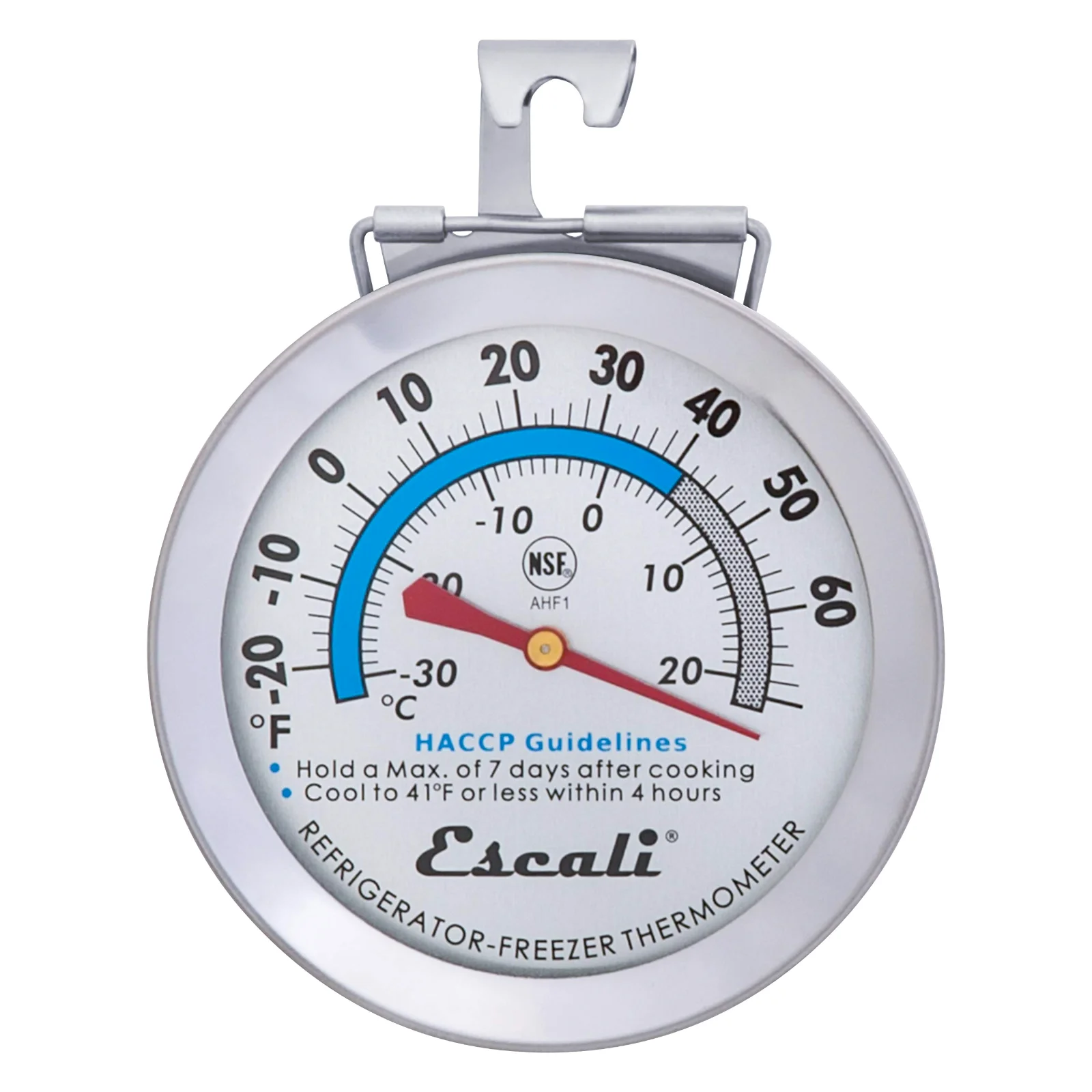
You open the refrigerator door. The light comes on, the compressor hums, and you glance at the control dial on the interior wall. It reads four. Four is not a temperature. The dial marked with numbers one through nine, or with ascending dots, is not a thermometer at all: it is a request for cooling, and it has no way to tell you what the air on the middle shelf actually holds. Over time, the relationship between the setting and the reality inside the box drifts in ways you cannot see. Dust settles on coils, a door gasket softens, a July kitchen leans on the outside of the shell, and the box that answered the dial faithfully in March runs warm in August while the setting stands unchanged. The Food and Drug Administration puts it plainly: few refrigerator controls show an actual temperature, and the advice is a freestanding appliance thermometer in the refrigerator and another in the freezer, checked often. The agency does not trust the dial, and neither should you.
The two numbers of the cold chain
The cold chain operates on two numbers. Forty degrees Fahrenheit is the threshold for the refrigerator. Zero degrees Fahrenheit is the threshold for the freezer. These are not preferences or ideals. They are the temperatures at which the biological processes of bacterial growth slow to rates that human storage can manage. Between forty and one hundred forty degrees, bacteria grow fastest, doubling in number in as little as twenty minutes. A single cell becomes a colony of thousands in the time it takes to watch a television episode. Below forty, that multiplication slows enough to buy you the days listed on storage charts. At zero, it slows to something close to a pause. Your refrigerator converts hours into days, but only if it actually holds at or below forty degrees, and your freezer holds the pause only at zero. The danger zone is not a vague concept. It is a window of exponential multiplication that begins the moment food warms above forty and continues until it cools below forty again or heats above one hundred forty. On the hot side of the same discipline, our oven-safe dials and instant-read probes serve the one hundred forty degree end of the window, marking when food has reached enough heat to exit the danger zone, and our kitchen timers carry the two-hour rule on a magnet to track how long food can remain in the ambient room temperature before entering the refrigerator.
Where the instrument lives
Where you place the instrument determines what you learn. Cold air falls, so the lowest shelf usually runs colder than the top one. The door is the warmest place in the compartment, met by a rush of room air every time you open it, and the back wall near the vent can read colder than the food ever gets. The middle shelf is the honest spot: the air there is closest to what your bulk food experiences. You set the thermometer there, and then you read it not once but across a week. A refrigerator cycles, defrosts, recovers slowly after a warm pot goes in, and labors harder in August than in February. A single reading is a snapshot that may catch a spike or a trough. A week of morning and evening readings is the truth. You write the numbers down, or you simply note whether the needle stays in the safe zone marked on the dial. Some people keep a small notebook in the drawer beneath the microwave. Others simply look for the pattern: does the needle rise during the afternoon heat, does it fall overnight, does it spike after grocery day when the door stood open for ten minutes while you loaded the shelves. You are learning the personality of your particular machine, its responses to the seasons and to your habits. Either way, you are looking for stability, and you adjust your control dial until the middle shelf holds steady at or below forty.
| What is being checked | Federal figure | The instrument that reads it |
|---|---|---|
| Refrigerator compartment | At or below 40 F | AHF1, AHF2, or DHF1 |
| Freezer compartment | At 0 F | AHF1, AHF2, or DHF1 |
| Room temperature exposure limit | No more than 2 hours (1 hour above 90 F) | Kitchen timer |
| Post-power cut refrigerator safety | At or below 40 F, or above 40 F for 2 hours or less | AHF1, AHF2, or DHF1 |
| Frozen food refreeze safety | Ice crystals present or 40 F or below | AHF1, AHF2, or DHF1 |
We make three instruments for this exact task. The AHF1 is a stainless dial refrigerator and freezer thermometer that hangs from a shelf by its sturdy hook or stands on its own integrated base, with HACCP temperature zones printed directly on the face for immediate reference, and it carries NSF certification. The AHF2 is a shatter-proof glass tube thermometer that mounts with suction cups to the interior wall or shelf, also carrying safe zone markings and NSF certification, its red liquid column rising and falling with the air temperature. The DHF1 is a digital display refrigerator and freezer thermometer reading from minus four to eighty degrees Fahrenheit, with a large LCD that answers at a glance. The AHF1 suits anyone who wants a dial with no battery in it. The AHF2 holds a fixed position where you can always find it. The DHF1 reads to the degree. And the federal advice of one instrument per compartment is the reason this line exists at all: the dials are inexpensive enough to buy twice, once for the refrigerator and once for the freezer. Every card on our site prints the reading range next to the price, so you know the scope before you choose.
When the power goes out
The power cut is the moment when the thermometer earns its place. When the electricity fails, the clock starts. You keep the door closed to trap the remaining cold, but you do not know how long the outage will last. When the power returns, you do not guess based on how warm the kitchen feels or how long you think it was out. You read the thermometer before you open the door. If the refrigerator thermometer still shows forty degrees or below, the food inside should be safe. If the temperature rose above forty degrees, but for two hours or less, the food should still be safe. The freezer has its own logic. If the food still has ice crystals, or if the thermometer reads forty degrees or below, it can be safely refrozen or cooked. The crystals are a visible sign that the food has not fully thawed. If you are unsure how long the food has been above forty degrees, you throw it out. This is the hardest rule because it feels wasteful, but the cost of the discarded food is less than the cost of uncertainty. The thermometer does not prevent spoilage. It removes the guessing, gives you permission to keep what is safe, and gives you a clear instruction about the rest. A power cut with a thermometer in the box is a calm assessment rather than a panic.
The trip home
The cold chain extends beyond the kitchen walls. When you bring raw meat, poultry, seafood, eggs, or produce that needs refrigeration home from the store, you are still on the clock. These items should never sit at room temperature for more than two hours, or one hour if the ambient temperature is above ninety degrees Fahrenheit. A hot car counts as room temperature above ninety, even if the windows are cracked. The steering wheel burns your hands, the seatbelt metal is untouchable, and the trunk is an oven, yet the bacterial doubling continues unaffected by your discomfort. The thermal mass of the food works briefly in your favor, but only briefly. A solid roast will hold its cool core longer than a tray of cutlets, but even the roast succumbs eventually. This is why the timer on your counter matters as much as the thermometer in the fridge. Our kitchen timers carry the two-hour rule on a magnet, a reminder that the danger zone does not begin when you open the package, but when the meat leaves the refrigerated case at the store. You put the bags on the counter, you set the timer, and you put the food away in shallow containers for quick cooling before the bell rings. The continuity matters. The cold chain is only as strong as its weakest link, and the parking lot in summer is often where the chain breaks.
What the thermometer buys you
Once inside and properly chilled, the storage times begin, but only if the thermometer confirms the environment. Ground meats and stew meat keep for one to two days. Fresh steaks, chops, and roasts keep for three to five days. Fresh whole poultry or parts keep for one to two days. These intervals assume the box is actually at forty degrees. If your refrigerator holds forty-five, the bacteria are multiplying faster than the storage chart anticipates, and the one-to-two-day window closes early regardless of what the calendar says. The shallow container rule applies here too. Leftovers go into shallow containers for quick cooling and into the refrigerator within two hours. A deep pot of stew placed hot into the fridge can warm the surrounding air and the food nearby, pushing the local temperature above forty and shortening the safe life of everything on the shelf. The thermometer buys you the full time promised by the charts. It confirms that the environment matches the assumption behind the storage data.
The fridge and freezer dials sit on the thermometer shelf of the Escali lineup, beside the probes that serve the hot end of the same window.
The honesty of the reading
There is a final honesty to observe. The thermometer reports. The federal figures decide. A refrigerator that reads forty-five degrees Fahrenheit is not a matter of opinion. It is not a suggestion or a guideline. It is a reading that falls outside the safety threshold established by the Food and Drug Administration and the Food Safety and Inspection Service. The instrument does not prevent illness. It does not guarantee safety. It does not kill bacteria or create barriers. It simply tells you whether the number you need is present. You adjust the control dial, or you call for service, or you discard the food, based on that reading. You do not negotiate with the number. You do not average it with yesterday's reading. You accept it, and you act. The dial on your control panel is a request. The thermometer is the reply.
The dial on your control panel is a request, not a reading.
One button, the whole Escali range
Every capacity, probe length and colour in the Escali lineup sits behind this button, with the current price beside it. Match the figure to your counter, and it ships from our retail partner.