The cup is a guess: baking by grams
Two cooks following the same cup recipe are baking two different formulas, and neither of them knows it. A scale, one bowl and a tare button settle the argument for good.
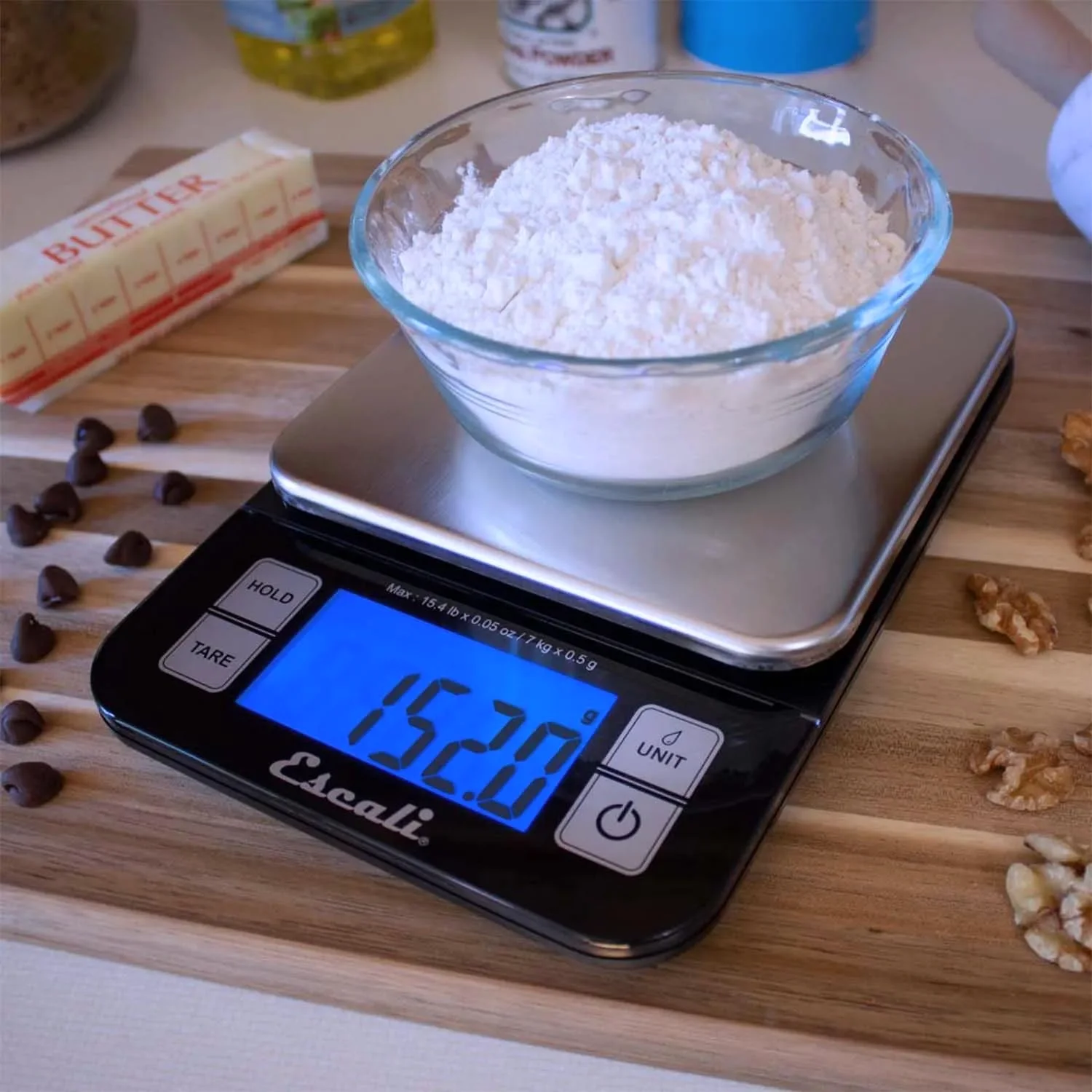
You stand at the counter with a bag of flour and a recipe that calls for two cups. You dip the cup into the bag, level it with the back of a knife, and tip it into the bowl. The flour was compressed from sitting on the shelf, or perhaps it was fluffed from recent sifting. You do not know how many grams entered the bowl. The next day, a friend bakes the same recipe with the same cup. Her flour was settled deeper in the bag, or she scooped with a heavier hand, or the humidity was higher and the particles clumped tighter. Her cup holds more grams than yours did. The two loaves rise differently, brown differently, and taste different in the crumb. One is tight and dry, the other slack and wet. You blame the oven, the yeast, the altitude. The real culprit is the cup. The cup is a guess. It is a variable you cannot control, and it turns baking into a lottery.
Weight does not guess. A gram is a gram in every kitchen. When a formula lists 250 grams of flour, you place the bowl on the platform, zero the display, and pour until the numbers read 250. The flour does not care if it was sifted, compressed, or humid. The weight is the weight. This is the shift from volume to mass. It changes how you bake, how you clean up, and how you think about ratios. It removes the argument between cooks about whose cup is correct. It ends the mystery of why the same recipe works on Tuesday and fails on Saturday. It gives you consistency, and consistency is the foundation of skill.
Why volume drifts
Flour is a powder of irregular particles with air between them. How you fill the cup determines how much air you include. A cup scooped from a settled bag can weigh significantly more than a cup of sifted flour spooned gently into the same measure. That difference is not trivial in a lean dough. It is the margin between a tight crumb and a dense one, between a cookie that spreads and one that holds its shape, between a cake that domes and one that sinks. Brown sugar packs down with the pressure of the scoop until it is nearly solid. Powdered sugar fluffs up with static electricity and resists settling. Rolled oats fill a cup differently if you shake the cup to level it or leave it heaped. Shredded coconut compacts. A cup of chopped walnuts or chocolate chunks depends on how the pieces fell and how large the gaps are between them. A cup of honey or molasses leaves a film in the vessel that volume cannot account for, while weight records what actually entered the bowl. The drift is not a minor inconvenience. It is a variable that changes the hydration percentage, the salt concentration, and the final chemistry of the bake. Two cooks following the same volume recipe are baking two different formulas. The variance compounds when you multiply ingredients. If your cup of flour is heavy and your cup of sugar is light, the balance of sweetness to structure shifts twice, and you have no way to diagnose the failure.
What the tare button changes
Weighing into one bowl replaces the tower of measuring cups that once cluttered the counter and the sink. The method is simple. Set your mixing bowl on the scale and press tare. The display reads zero. Add the first ingredient to the target weight. Press tare again. The display returns to zero. Add the next ingredient. You build the entire formula in one vessel without arithmetic or intermediate cups. You do not dirty a quarter-cup, a half-cup, a full cup, and a set of spoons. You wash the bowl you mixed in and wipe the scale platform with a damp cloth. The Primo, with its eight and a half by six inch footprint, leaves room on the counter for this workflow, and a stainless tray for it is sold separately if you prefer a removable surface for cleaning.
The Pana V136 offers a bridge between worlds, preprogrammed with over 150 ingredients to show volume equivalents for the weight you have measured, but even it begins with the gram on the display. The tare button hides the weight of the bowl from the display, but the scale still feels it. The bowl is part of the total load on the load cell. This matters when you choose a platform, and we will return to it. For now, consider what tare does for error correction. When you pour flour from the bag, you watch the digits climb. If you pass the target by ten grams, you see it immediately. You scoop out the excess and watch the numbers fall back. With a measuring cup, you do not know you have erred until the loaf emerges from the oven. The scale makes the mistake visible while it is still correctable. You can add the salt slowly and stop at exactly two grams. You can drizzle oil until the reading lands on forty grams. You can add yeast a few grains at a time to hit the precise amount for a cold proof. The precision is live and reversible. The tare button turns the scale into a running tally of your recipe, ingredient by ingredient, without ever pouring anything out of the bowl to measure it separately. It saves time and prevents the waste of overpours.
Capacity arithmetic
Every scale in our catalogue lists a capacity. The Primo, our longest-serving platform, carries up to eleven pounds. The Arti handles fifteen. The ArtiXL stretches to twenty-two. These figures include everything on the platform. When you set a heavy ceramic mixing bowl or a cast iron dutch oven on the scale and press tare, the display zeroes, but the bowl has already claimed part of the eleven pound ceiling. A big enameled dutch oven can spend most of that ceiling by itself, before the first ingredient lands. The Pana V136, with its thirteen pound capacity and volume conversion features, lives within the same arithmetic.
This is why we build larger platforms. The Arti at fifteen pounds and the ArtiXL at twenty-two exist for cooks who weigh directly into the vessels they cook in. The ArtiXL’s tempered glass surface sits only three quarters of an inch tall, so a tall stockpot does not topple. The M-Series, certified for kitchen and industrial use, reaches sixty-six pounds with a spill-proof stainless face for production baking or serious batch cooking. Choose a capacity that leaves room for the bowl and the food together. The load cell does not distinguish between flour and container. It only knows the total mass pressing down. If you exceed the capacity, the display will error or the reading will freeze, and you will not know if you have added the correct amount until you remove the excess and start again. The Arti also includes a nutrition and calorie display for those tracking intake, but its primary virtue is the fifteen pound ceiling that accommodates serious bowls.
| Scale | Capacity | Finest Increment | Kitchen it suits |
|---|---|---|---|
| Primo | 11 lb | 1 g / 0.05 oz | Everyday baking, portioning dinners |
| Arti | 15 lb (7000 g) | 1 g / 0.1 oz | Home bakers using heavy mixing bowls |
| ArtiXL | 22 lb | 1 g / 0.1 oz | Stockpots, dutch ovens, large batches |
| Telero | 11 lb | 1 g / 0.01 oz / 0.001 lb | Precision work, small additions |
| M-Series | 66 lb | 2 g | Professional kitchens, industrial prep |
| L600 Lab Balance | 600 g | 0.1 g | Spice blending, fine chemistry |
Reading the increments
Capacity tells you how much the scale can hold. Increment tells you how finely it reads. Most kitchen work resolves cleanly to the gram. Bread doughs, dinner portions, and batch cooking operate comfortably at one gram resolution. The Primo reads in grams or 0.05 ounce increments across its eight color options. The Arti and ArtiXL read to the gram or the tenth of an ounce. For most home baking, this is enough. A gram of salt in a loaf is perceptible but not destructive, and a whole-gram display is honest about what it can and cannot tell you.
Finer increments help when you work in small amounts or when the ratio is critical. The Telero offers thousandths of a pound or hundredths of an ounce alongside the gram, selectable in three colors. This matters for adding yeast to a small dough, or salt to a single loaf, or anything sold in a tin so small that a whole gram is a coarse stroke. Saffron is sold by the fraction of a gram. When you move below a gram, you leave the kitchen platform for the lab balance. The L600 reads to a tenth of a gram across a six hundred gram capacity. The L-Series resolves to a hundredth of a gram. These speak six units including grains and carats, and they serve spice blending, coffee work, and any bench where a tenth of a gram changes the outcome. The increment is honest information. A scale that reads only to the gram cannot tell you whether you have one point four grams or one point six grams of baking powder. It rounds. For most recipes, the rounding is harmless. For some, it accumulates across many small additions. Choose the increment that matches the precision your formula demands.
Bakers' percentages
Professional formulas do not list cups. They list percentages. In this system, flour is always one hundred percent, and every other ingredient is expressed as a share of the flour weight: water as so many parts per hundred parts of flour, salt as a small number of parts, yeast as fewer still. The flour anchors the whole formula, and everything else hangs from it.
This language only works with a scale. You cannot calculate percentages from volume because volume varies. You cannot tare and add with a measuring cup. The scale is the entry ticket to the system. Once you are inside, scaling recipes becomes simple arithmetic. If you want to double the batch, you double the flour weight and every other ingredient follows. The baker's percentage removes the hidden variables of scooping and settling. It is a grammar that requires the vocabulary of grams: it lets a baker in Denver and a baker in Miami bake the same loaf from the same formula, because the ratios are locked to the mass of the flour, not the volume of the cup. A wetter formula reads wetter at a glance and a stiffer one reads stiffer, but every one of those readings is meaningless if the flour weight itself is uncertain.
The mechanical dial
Not every scale in our catalogue runs on batteries. The Mercado DS115B is a mechanical dial with a removable stainless bowl. It reads to eleven pounds without a circuit board. On the day every battery in the house is dead, the Mercado still turns. It trades the fine increments of a digital platform for independence from power. The dial moves a needle across a printed face. It is slower to read than a seven-segment display, and it resolves to broader strokes: you set the empty bowl on top, bring the needle back to zero, and read the weight along the printed arc.
For the cook who values reliability over precision, or who simply prefers the analog gesture, it is an honest outlier. It does not offer tare in the digital sense, though you can zero the dial with the empty bowl on top. It does not read fractions of a gram. It tells you that you have roughly four ounces of butter, not four point two. For pie dough or pancake batter, that is often enough. The Mercado is the scale that works when the lights are out and the batteries are drained. It is a mechanical backup to the digital precision of the Primo or the Arti. The removable bowl makes it easy to transfer ingredients or clean up after sticky work. There is a satisfaction in the physical deflection of a spring that no digital sensor can replicate.
Checking the display
A scale is a tool that can lie. Vibration, temperature swings, rough handling, or simple age can drift the load cell. You verify it against a known mass. We stock a five thousand gram stainless calibration weight for exactly this purpose. Place it on the platform. If the display reads five thousand grams, the cell is true. If it reads forty-seven hundred or fifty-one hundred, the scale needs adjustment or replacement. The calibration weight is a known constant against which you test the instrument.
In the kitchen, you can perform an informal check with a sealed, unopened bag of sugar. The bag states its net weight on the label. Place it on the scale. The reading should match the printing. If it drifts by more than the scale's rated increment, treat the display with suspicion until you can test it against a proper calibration mass. A five pound bag should read five pounds. A kilo bag should read one thousand grams. Trust, but verify. The gram you measure is only as good as the scale's last check. Every card on our site prints the capacity and the increment next to the price, so you know the tolerance you are buying. The known mass tells you whether to trust the display today. Check after a move, after a drop, or when a recipe keeps failing despite careful following. The weight is the weight, but only if the scale is true.
The calibration weight lives on the pro bench of the Escali catalog, beside the lab balances it was machined to check.
The cup is a guess, but the gram is a contract.
One button, the whole Escali range
Every capacity, probe length and colour in the Escali catalog sits behind this button, with the current price beside it. Match the figure to your counter, and it ships from our retail partner.